Plastic material classification:
1. PET: It is an environmentally friendly material and can be directly contacted with cosmetics and food. It is the main material for filling organic skin care products. The PET material is soft and its natural color is transparent.
2. PP and PE: They are environmentally friendly materials, which can be directly contacted with cosmetics and food. They are the main materials for filling organic skin care products. The natural color of the materials is whitish and translucent. According to different molecular structures, three different degrees of softness and hardness can be achieved.
3. AS: The hardness is not high, it is relatively brittle (there is a crisp sound when tapping), the color is transparent, and the background color is blue, which can be directly contacted with cosmetics and food. In ordinary lotion bottles and vacuum bottles, the bottle body is generally the bottle body. The material can also be made into a small-capacity cream bottle. appear transparent.
4. PCTA and PETG: They are environmentally friendly materials that can be directly contacted with cosmetics and food. They are the main materials for filling organic skin care products. The materials are soft and transparent. PCTA and PETG are soft and easy to scratch. Infrequently, inkjet printing is not often used, and printing is often used.
5. Acrylic: The material is hard, the transparency is high, and the background color is white. And acrylic is often sprayed inside the outer bottle in order to maintain a transparent texture.
6. ABS: It belongs to engineering plastics, which is not environmentally friendly and has high hardness. It cannot be directly contacted with cosmetics and food. It is generally the material of outer cover and shoulder cover in cosmetic packaging materials. The color is yellow or creamy white.
Types of packaging bottles:
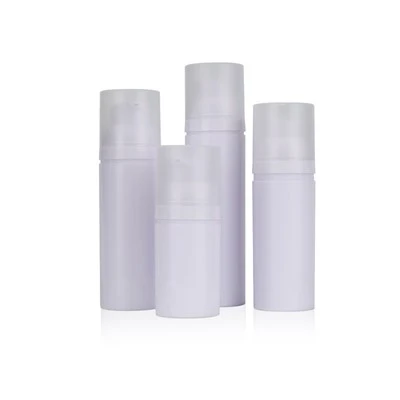
1. Vacuum bottle: lid, shoulder sleeve, vacuum pump, piston. Use by air pressure.
The pump head is generally a pointed head or a flat head with a duckbill. The vacuum bottle has a high sealing performance. The vacuum pump will move up with the reduction of the inner material, and the leakage will affect a certain aesthetics.
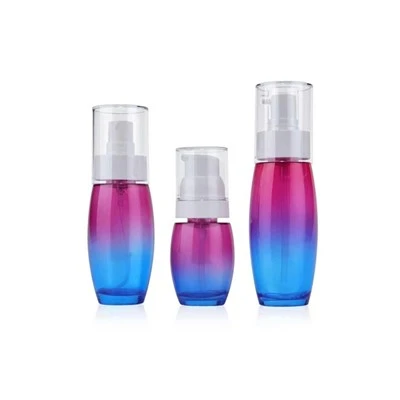
2. Lotion bottle: consists of lid, shoulder cover, and lotion pump. Most are equipped with straws inside.
Single-layer and multi-layer bottles are generally made of acrylic on the outside and PP on the inside. The cover is acrylic outside and ABS inside.
3. Perfume bottles: mostly lids, spray heads, bottle bodies, and straws. Large-capacity ones are commonly made of glass because of longer storage time. There are also interiors that are glass exterior aluminum. PP bottles are suitable for short-term storage of small volumes.
4. Cream bottle: there is an outer cover, an outer bottle, an inner tank and a gasket.
Acrylic Double Layer Cream Bottle: Body Acrylic, Cap, Gasket PP. Acrylic is more transparent and expensive. PP double layer cream bottle: the bottle body and lid are all made of PP. The transparency is not high, suitable for the design with color. PET single-layer bottle body, PP, PE, PS and other materials. It can be used in combination with related materials such as external anodized aluminum and cover external anodized aluminum.
5. Blow molding bottle: the material is mostly PET material. There are three types of lids: screw lid, flip lid and Qianqiu lid. Blow molding is the direct blowing of the preform.
The characteristic is that there is a bump on the bottom of the bottle. Brighter in light.
6. Blowing bottle: the material is mostly PP or PE. The cover is divided into three types: Qianqiu cover, flip cover and screw cover. Blow molding is a process that combines blow molding and blow molding, requiring only one mold. The characteristic is that there is a bonding line at the bottom of the bottle.
7. Aluminum-plastic hose: the innermost is PE material and the outer is aluminum packaging. The commonly used processes are offset printing, silk screen printing, and hot stamping.
8. All-plastic hose: commonly used PE, PP, PVC materials, and the hose is pulled out first and then cut, and the commonly used processes are offset printing, silk screen printing, and hot stamping.